Address
C-181, C Block, Sector-63, Noida, Gautam Budha Nagar, Uttar-Pradesh, 201301, India
Work Hours
Monday to Friday: 7AM - 7PM
Weekend: 10AM - 5PM
Address
C-181, C Block, Sector-63, Noida, Gautam Budha Nagar, Uttar-Pradesh, 201301, India
Work Hours
Monday to Friday: 7AM - 7PM
Weekend: 10AM - 5PM
Buying a telescope can completely change the way you experience the night sky. The Moon’s craters, Jupiter’s moons, Saturn’s rings, bright star clusters, and other celestial objects become far more fascinating when you can observe them through quality optics. But with so many models, specifications, and price ranges available, choosing the right telescope can feel confusing, especially for a first-time buyer.
The search for the Best Telescopes in India should not begin with magnification or price alone. A good telescope is a combination of optical quality, aperture, mount stability, usability, and the type of objects you want to observe.
Whether you are a beginner, student, parent looking for an educational telescope, or an experienced stargazer, understanding the important specifications before buying can help you make a more confident decision.
The Best Telescopes in India are not necessarily the models with the highest advertised magnification. Instead, look at the complete package and determine whether its specifications match your actual astronomy requirements.
The most important factors include:
Understanding these specifications will help you compare telescopes based on performance rather than marketing claims.
Aperture is one of the most important specifications to understand before purchasing a telescope. It refers to the diameter of the primary lens or mirror responsible for collecting light.
A larger aperture generally allows a telescope to collect more light. This can help reveal greater detail and make fainter celestial objects easier to observe under suitable sky conditions.
For beginners, choosing an appropriate aperture is often more important than chasing extremely high magnification. If your goal includes observing planets as well as brighter deep-sky objects, consider a telescope with sufficient light-gathering capability.
This is one of the first things experienced users consider when comparing the Best Telescopes in India.
Magnification is probably the specification most beginners notice first. However, more magnification does not automatically mean better viewing.
A telescope’s useful magnification depends on factors such as:
Excessive magnification can produce a larger but blurry image if the optics and viewing conditions cannot support it.
For this reason, a telescope offering a sensible combination of aperture, optics, and useful magnification is generally a better investment than one advertised mainly around an extremely high power number.
Telescopes are available in different optical configurations, and each has its own advantages.
Refractors use lenses to collect and focus light. They are generally straightforward to operate and can provide sharp views of the Moon and planets.
They can be a practical choice for beginners who want simple operation and relatively low maintenance.
Reflectors use mirrors instead of objective lenses. Newtonian reflector telescopes are particularly popular among astronomy enthusiasts because they can provide substantial aperture at a competitive cost.
They can be suitable for planetary observation as well as many brighter deep-sky targets.
Compound designs combine lenses and mirrors. They can provide strong optical performance in a relatively compact body, although their construction can make them more expensive.
Before selecting from the Best Telescopes in India, understand which optical design fits your observing goals.
Even excellent optics can become frustrating to use when paired with an unstable mount.
The mount supports the optical tube and allows you to aim the telescope at different objects.
An altazimuth mount moves vertically and horizontally. It is generally simple to understand and can be suitable for beginners and casual observation.
An equatorial mount is designed to make tracking celestial objects easier as the Earth rotates. With proper alignment, it can provide smoother tracking and is particularly useful for enthusiasts who want more precise astronomical observation.
Therefore, mount quality should always be considered alongside the telescope’s optical specifications.
Optical quality has a direct effect on what you see through the eyepiece.
Features such as multi-coated or fully multi-coated optics can improve light transmission and help reduce unwanted reflections. Good optics can provide better contrast, brightness, and overall image quality.
When comparing the Best Telescopes in India, don’t judge a telescope simply by its appearance or advertised power. The quality of its optical system matters considerably.
Your observing goals should influence your purchase.
Almost any decent astronomical telescope can provide an impressive view of the Moon. A model with good optics and appropriate magnification can reveal craters, mountains, and other lunar features.
If planets are your main interest, prioritize good optics, adequate aperture, stable mounting, and suitable focal length.
Observing galaxies, nebulae, and star clusters requires sufficient light gathering. A larger aperture can be particularly useful when observing under darker skies.
Knowing your target objects makes it much easier to choose between different telescope models.
A technically impressive telescope is of little value if you find it difficult to assemble or operate.
Beginners should consider:
The easier a telescope is to use, the more likely you are to use it regularly. This is particularly important for students and families purchasing their first astronomy equipment.
Best telescopes in india with similar specifications may offer different value depending on their included accessories.
Useful accessories can include:
However, don’t purchase a telescope simply because it comes with a large number of accessories. Quality and usefulness are more important than quantity.
If you are purchasing your first telescope, avoid making the decision based purely on the Best Telescopes in India search results or the highest advertised magnification.
Instead, look for a balanced model with:
A beginner-friendly telescope should encourage exploration rather than create a complicated learning curve.
Experienced users may have more specific requirements. Depending on their interests, they may prioritize larger apertures, equatorial mounts, better tracking, improved optics, or compatibility with additional accessories.
For serious astronomy enthusiasts, the right telescope is often determined by the type of observation they plan to conduct rather than simply by the budget.
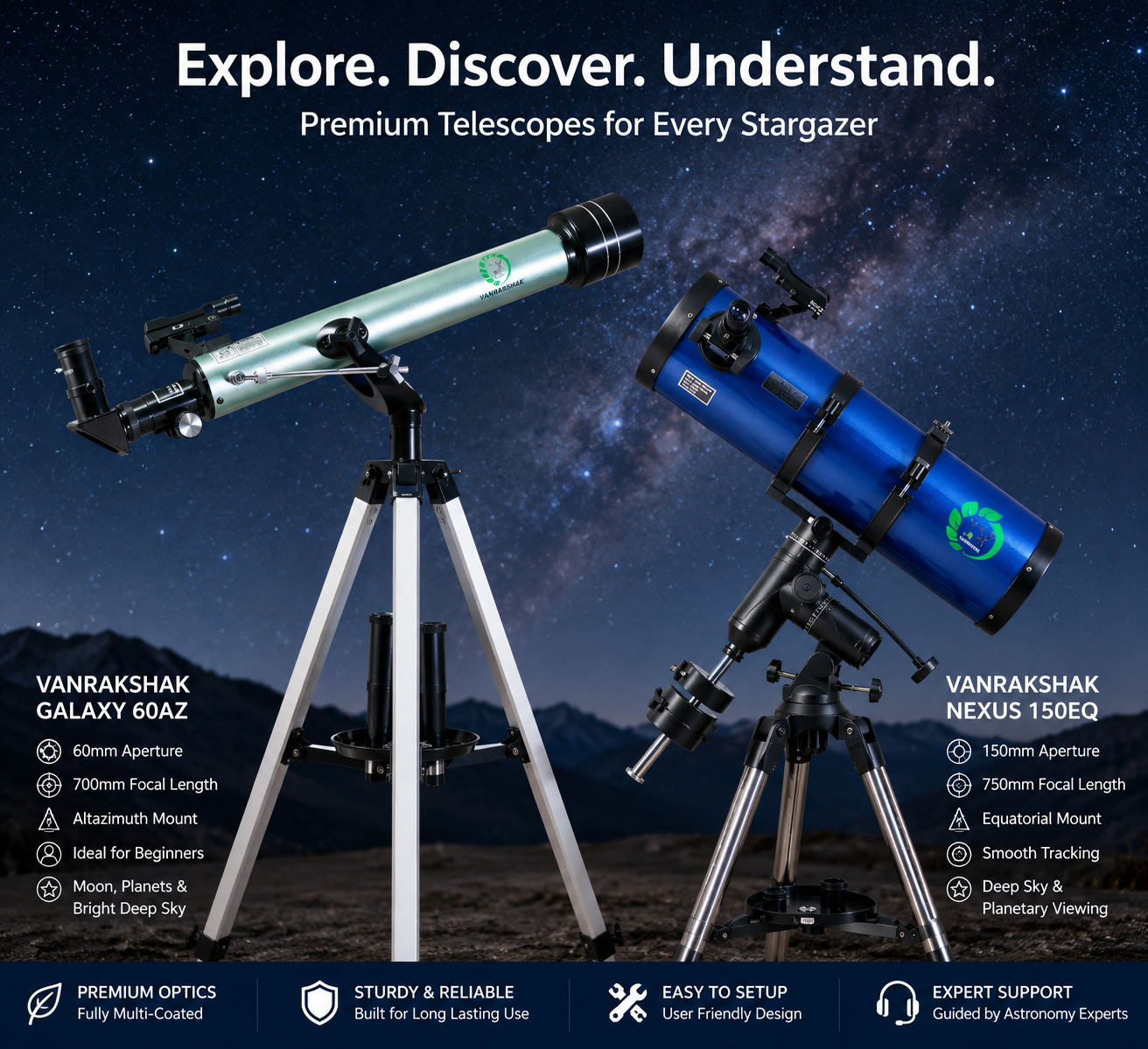
For Indian buyers searching for dependable astronomy equipment, Vanrakshak offers telescope models designed for different levels of interest and observation.
For example, the Vanrakshak Galaxy 60AZ is positioned as a practical option for users looking for a straightforward astronomical telescope. Its 60 mm optical system, 700 mm focal length, fully multi-coated optics, altazimuth mount, slow-motion controls, multiple eyepieces, Barlow lens, and red dot finderscope make it suitable for users who want to explore the night sky without an unnecessarily complicated setup.
For users looking for a larger aperture and more advanced observing capability, the Vanrakshak Nexus 150EQ offers a different experience with its 150 mm Newtonian reflector design, 750 mm focal length, fully multi-coated optics, and equatorial mounting system.
These examples highlight an important point: there is no single telescope that is perfect for everyone. The right choice depends on experience, observing goals, portability requirements, and expected performance.
Before purchasing, avoid these common mistakes:
Choosing maximum magnification: High power is useful only when the optical system and conditions can support it.
Ignoring the mount: An unstable mount can make even good optics difficult to use.
Buying without knowing your purpose: A telescope for casual Moon viewing may have different requirements from one intended for deeper astronomy.
Focusing only on price: The cheapest option is not always the best value, while the most expensive model may offer features you don’t need.
Ignoring portability: If you plan to travel with the telescope, consider its size and weight before purchasing.
The Best Telescopes in India for beginners should combine good optics, an easy-to-use mount, suitable aperture, simple focusing, and straightforward setup. A balanced telescope is generally better for learning than one focused only on extremely high magnification.
The ideal aperture depends on your observing goals. Smaller apertures can work well for beginners and basic Moon and planetary viewing, while larger apertures collect more light and can reveal more detail and fainter objects.
Not necessarily. Magnification must be supported by the telescope’s aperture, optical quality, mount stability, and atmospheric conditions. Excessive magnification can produce an enlarged but blurry image.
A telescope with good-quality optics, suitable aperture, appropriate focal length, and a stable mount can provide excellent planetary views. The atmosphere and observing location also have a significant effect on what you can see.
Check aperture, optical design, focal length, mount type, optical coatings, build quality, included accessories, ease of setup, and whether the telescope suits your intended targets. Comparing these factors will help you make a more informed purchase.
Choosing the Best Telescopes in India becomes much easier once you know which specifications actually influence the viewing experience. Instead of focusing only on magnification or price, evaluate the aperture, optical design, mount stability, optical quality, accessories, and ease of use.
For beginners, a simple and balanced telescope can provide an enjoyable introduction to astronomy. More experienced users may benefit from larger apertures, equatorial mounts, and advanced optical capabilities.
Whether your goal is to observe lunar craters, explore planets, identify star clusters, or begin a deeper journey into astronomy, choosing the right telescope is the first step. With models such as the Vanrakshak Galaxy 60AZ and Nexus 150EQ catering to different observing requirements, buyers can select equipment according to their experience and goals.
A good telescope is more than an optical instrument. It is an opportunity to learn, explore, and experience the night sky in a completely different way.